 by Marjorie Wall Hofer, TheCareerProfiler
November 14, 2024
The blame game among Democrats is raging but none of the arguments speaks to a fundamental innate human ability as a factor.
In the world of aptitudes and natural abilities, the focus is almost always directed at career or employment purposes. But it offers insights into the approaches each candidate has taken.
- Tangible-Intangible Innate Ability Dichotomy
- Buildings versus Words
- Simple versus Complete
- Fear versus Hope
- Bottom-line versus Principles
- Lies/Whatever versus Truth/True
- Male versus Female
- Intelligence versus Common Sense
- Common versus Professional
Tangible-Intangible Innate Ability Dichotomy
Let’s just focus on one innate ability: the natural, genetically acquired ability to see 3-D. Its one of the REASONabilitiesTM you were born with it; or you possess its opposite ability. I call it the tangible versus intangible dichotomy.
Assessing it has seen some changes however with recent attempts to improve scores with practice. In fact, the Labor Departments version, GATB turned Ability Profile on their O’Net platform, has been abandoned because of the ubiquity of practice tests. People could “cheat”. But given novel situations where conditions and elements change, the performance of jobs requiring this ability lie with those possessing this innate ability.
There are a couple of key things to note about this ability. Research into it began after WW1 when the US Military discovered that they needed a full-proof way to place recruits, and most especially under wartime conditions. The ASVAB is the military’s answer to that need.
But research continued when findings were shared with large corporations like GE, Ball Aerospace and A&T. When the post WW2 recruiting boom ended some spun their research arms into foundations. Even with affirmative actions sequestering research in educational sectors, discoveries beyond work applications have emerged.
With the 3-D ability, we know that those who possess it are compelled to work with their hands and with concrete tangible objects, like equipment, tools, vehicles, buildings to name a few. They see what works automatically, with comments about ideas like “yeah, but, when the rubber meets the road” it won’t work. Let’s call this realist thinking. Because they work with tangibles, they are not eloquent or verbose. They tell it like it is. Just think of the meme a traditional laborer who gets off from work wonders into the bar and complains that his wife wants to talk about feelings as he uses his hand to show what that means to him. Got the picture. Its extreme and stereotypical but images like this help us grasp a better of understanding than words alone.
People who do not possess this ability possess a different kind –proficiency with intangibles. They craft pictures by manipulating of words. Numbers and laws and policies and emotions are their playground. Because intangibles are concepts and ideas they do not need to ‘touch the ground’ but are left in the universe of imaginary space. Let’s call this idealist thinking. Just think of a defense lawyer in court crafting words into pictures that paint “innocence” on the face of the accused or a politician who shapes laws that govern our country.
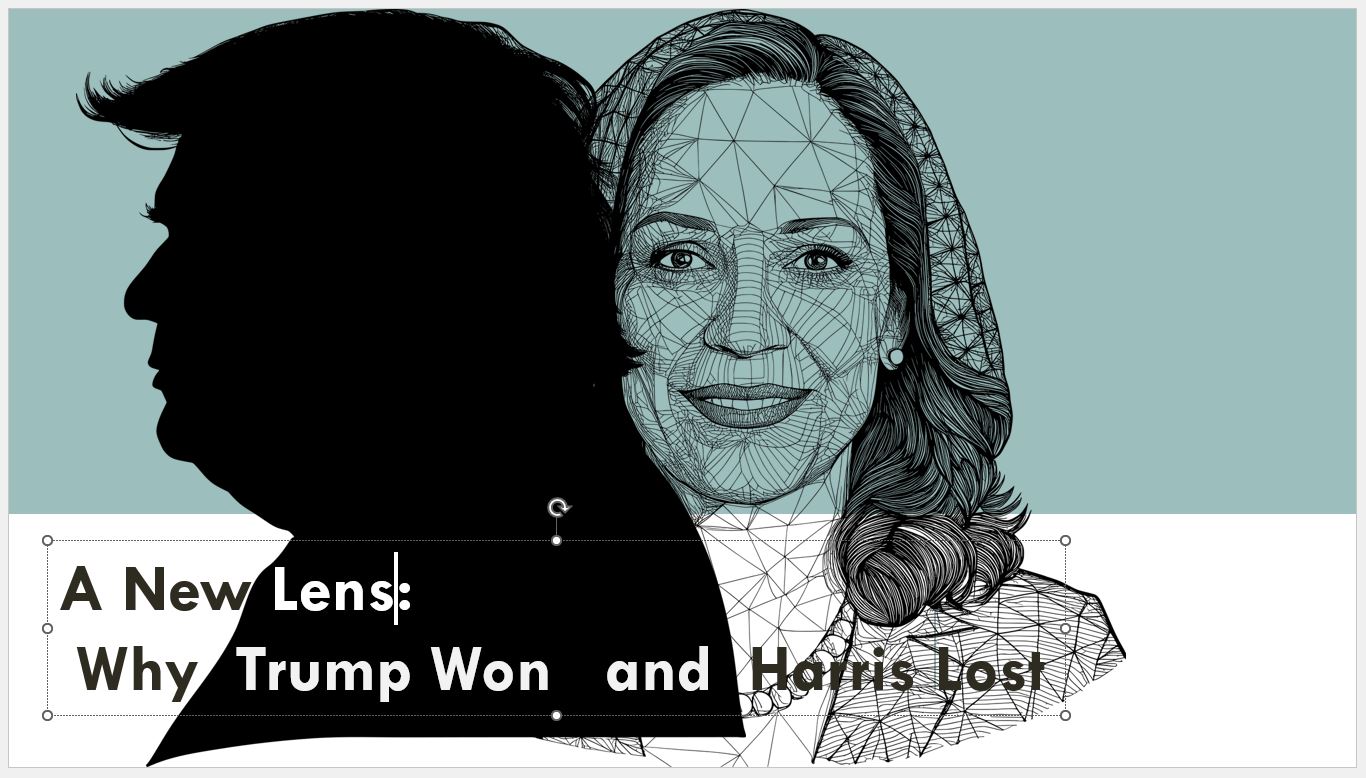
Thus, here we have the essence of Trump versus Harris performance in the 2024 election:
Buildings versus Words
Trump grew to fame as a real estate baron raising iconic buildings in New York and casinos on the Atlantic shores of New Jersey. He has become a master of building, not just physical structures, but campaigns that benefit himself first as a ‘ghost contributor’ to NYC media outlets and then in politics. Kamala, a lawyer, rose to prominence as California’s Attorney General and eventually was selected as Vice President of the United States of America. She has become a master of crafting intangible words to persuade juries to convict criminals.
Simple versus Complete
Trump has been condemned as a monosyllabic oaf who touts lies as truth. He slings simple words at us in rallies and on whatever media sources will carry or repeat his message. His simple words are memorable, and thus powerful. He slaps them together into a short phrase. His constituents parrot them like the bird extending his reach beyond media outlets.
Kamala, on the other hand, and much like Obama and Kerry, sought to carefully convey the nuanced meaning in words in order to ensure the full understanding of policies and positions. She answered TV anchor questions with too many words to be thorough and complete. It left viewers with no memorable slogan and ultimately cost her the attention and votes of listeners. Pundits correctly ascertained that Kamala “failed to find an effective message against Mr. Trump” Reid J. Epstein, Lisa Lerer and Nicholas Nehamas, “Devastated Democrats Play the Blame Game, and Stare at a Dark Future”. The New York Times, Nov. 7, 2024, viewed Nov 14, 2024, at 10:03 am MT.
Fear versus Hope
Trump extracts the fundamental thoughts usually fears held by constituents. He speaks to those fears and stokes them. While research tells us that fear motivates, Trump seems to know this intuitively. Fears drive people to seek safety. Trump was their savior. Make America Great Again was the ultimate message of messiah Trump.
Kamala, on the other hand, focuses on hope and joy. She presents herself as joyful to fearmongering Trump. She seems to carry this trait by nature. In contrast to the disunity and chaos sown by Trump, she presents pictures of hope and promise. She idealistically believes that hope will drive people to the polls. But we see that while people want hope and unity it doesn’t have the motivational power that fear has to garner votes.
Bottom-line versus Principles
The bottom-line objective is Trump’s focus. What works! That’s it. What ideas run on the road of life driving people to act. If Democrats had won, Trump stood a good chance of jail time. Bottom-line, he had to win the election. That bottom-line drove his campaign.
Harris, on the other hand, wants to ensure that she ‘earns people’s vote’. For her it is a process, not the bottom-line. She is driven to ensure that she does her job well. She focuses on the aspects of her job and presents herself as a worker bee, but not as a president. She held her work to a higher standard and hoped it would demonstrate her ability to lead when it conveyed her diligence and laudable principles.
Lies/Whatever versus Truth/True
Truth matters little to Trump. In fact, the opposite seems to be his forte. While I’m focusing on his realist thinking profile, it warrants mentioning the “nurture side” of the equation here. The trauma of abandonment at the age of 2, when Trump’s mother landed in the hospital for months after the birth of his brother, has played an impactful role in his abandonment of principle over self-preservation. While at one time his goal was to be famous, his need to win the presidency is all encompassing. He will say whatever it takes to win him the votes. Thus, truth matters little. And he knows too that repeating a lie often enough, which he has mastered, becomes ‘truth’ in the ears of listeners. His followers grow in numbers because they’ve been equipped to parrot his easy-to-repeat lies as truth.
On the other hand, Kamala stood by her principles. She would not debase herself by using Trump’s winnable tactics. She stuck with the careful crafting of messages conveying complete and holistic truth using long phrases and lots of words to convey essential subtleties held within word combinations and phrases. She chose words like “unfit for office” over simple more powerful ones like “terrible person” to describe Trump. She outlined policies articulated in detail to ensure its truthfulness but lost on the listener in doing so. While she captured the enthusiasm of the center and left at Biden’s departure, her numbers steadily declined as she wore out her followers with benign though fully truthful joyful messages.
Male versus Female
Gender votes also bear witness to this dichotomy. Three-D realist, those who need to work with tangibles, are more often men. Extensive research bears out more men possess the 3-D ability than women and testosterone play a role in its expression. More men are like Trump. And so, it should be no surprise that Trump attracted white men from the beginning and, in this election, gained ground among black and Hispanic men. They resonate on the same frequency. They understand the world in the same way.
On the other hand, women tend to score higher on the intangible, idealist end of the scale. And, in fact, Harris did better among women. One might argue that her position on abortion was the reason, and I have no doubt that it played a role, but to cement in her female followers, she spoke of things and in ways that resonate more with females, and its not just because she is female herself. More women see life through the idealist lens that Harris does.
Intelligence versus Common Sense
Finally, I want to bring in one more natural ability, vocabulary. It is often used as a measure of intelligence. Common sense is another matter more related to 3-D ability which one could call street smarts. Given Trump’s choice of words, he would not be marked as an intelligent man but standard measures. But he bears the marks of a man with common sense. Harris on the other hand has achieved high grades in law school and to pass the bar and risen from lawyer, one of the most language dependent occupations, to attorney general before becoming vice president. She bears the grades of an intelligent person.
Common versus Professional
Vocabulary is also an indicator of one’s natural ‘audience’. People are attracted to those who speak their language. In essence, the words people use naturally. The greatest number of people in society possess a simple vocabulary – simple common words without attention to nuance. This is how Trump speaks. He uses common words that speak to ‘common’ people, and that’s where most of us score.
On the other hand, lawyers, like Kamala, must possess a strong command of language. The job demands that they develop an extensive vocabulary even beyond their natural language level. At this level, words are coined to convey nuances of meaning not simple terms. Those who resonate with this type of language are often of the professional ranks of society. And, if you haven’t noticed, there are fewer of them than common folk. Obama, I noticed, worked hard not to make the mistakes of Kerry in speaking to the people instead of executives. But Kamala failed to learn this lesson, or maybe she simply didn’t have time to do so. If you want to attract the masses, a common simple vocabulary is key. Nuanced language is for those in law, legislation and professions.
The debate about why the Democrats lost the 2024 election go well beyond vocabulary and natural abilities but I could see that her chances of winning the election were dim simply given the behaviors associated with the 3-D ability dichotomy. It turns out that prediction was correct.
To see where your fall on this REASONability dichotomy as well as others, consider taking The Highlands Ability Battery (THAB) from TestEts.com, my assessment website.